Why Your A++ LED Bulb Is Now Rated F - The New Energy Labels Explained
Posted by Light Shop Direct on 24th Apr 2026
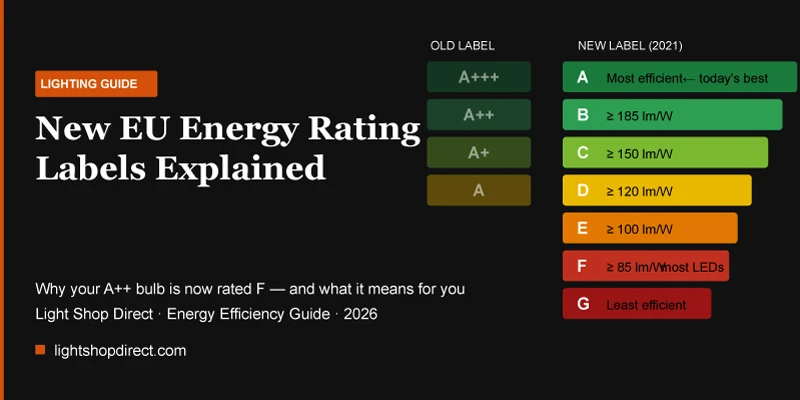
Why the energy labels changed in 2021
The original EU energy label used a scale from A (most efficient) to G (least efficient). As LED technology improved over the following decade, extra categories were bolted on A+, then A++, then A+++. By 2020, the scale had become so crowded at the top that almost every modern LED light bulb carried an A++ or A+++ rating, making it impossible to compare products meaningfully.
The European Commission scrapped the plus categories entirely and reset the scale to a clean A–G system under Regulation (EU) 2019/2015, which came into force on 1 September 2021. The same regulation was adopted into UK law under The Ecodesign for Energy-Related Products and Energy Information (Lighting Products) Regulations 2021. The thresholds were deliberately raised to reserve the A and B bands for the next generation of lighting technology still in development.
Old scale vs new scale side by side
The product hasn't changed. The efficiency hasn't changed. Only the letter has changed. Here's how the two scales compare for LED bulbs:
| Old Rating (pre-2021) | New Rating (2021+) | Efficiency (lm/W) | Typical product |
|---|---|---|---|
| ≥ 120 lm/W | Standard LED GLS | ||
| ≥ 100 lm/W | Most modern LED bulbs | ||
| ≥ 85 lm/W | LED candles, GU10s | ||
| ≥ 50 lm/W | Older or decorative LEDs | ||
| < 50 lm/W | Halogen, incandescent |
Under the new system, A and B ratings are currently nearly empty — reserved for technologies not yet in mainstream production. The best of today's LED market sits at C, D and E. An F-rated LED under the new system is still far more efficient than any halogen or incandescent bulb ever was.
How to read the new energy label
Every new label follows a standardised format. Here's what each part tells you:
Top of label
Supplier & Model
The manufacturer name and model number — useful for cross-referencing the EPREL database for full technical data.
Centre of label
A–G Scale
The coloured bar from dark green (A) to red (G), with an arrow showing where this product sits on the rescaled system.
Below the scale
kWh/1000h
Energy consumption per 1,000 hours. The most practical number — use it to calculate real running costs directly.
Top right corner
QR Code
New to the 2021 label. Scans to the EU's EPREL database where you can verify the full product specification sheet.
The most useful number on the label
The kWh/1000h figure tells you exactly how much electricity a bulb uses over 1,000 hours. A bulb rated 8 kWh/1000h will cost roughly £1.60 to run for 1,000 hours at the UK average electricity rate of around 20p/kWh. That's the number to compare — not the letter.
Why has my efficient bulb dropped to F or G?
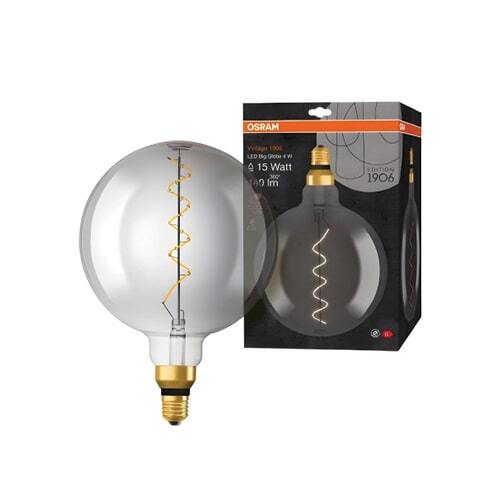
This is the question we hear most often. Someone buys an Osram or Integral LED bulb previously rated A++, and finds the new packaging shows an F. Nothing has changed about the bulb. It produces the same light. It uses the same electricity. It will last just as long.
What changed is the measuring stick. The new efficiency thresholds were deliberately set far above what current mainstream technology can achieve. The vast majority of commercially available LED GLS bulbs, LED candle bulbs and GU10 spotlights now fall between E and G — and that is entirely expected and correct.
What is an LED Class A bulb?
A true LED Class A rating under the 2021 system means the bulb achieves an energy efficiency index placing it in the top band of the rescaled A–G system. In practice, these are high-specification bulbs engineered with the most advanced LED chips and driver electronics available, typically producing 150 lm/W or above.
New 2021 A–G energy scale for lighting
We stock a growing range of A-class LED light bulbs achieving the new top-band rating in BC (B22) and ES (E27) fittings — the most energy-efficient bulbs commercially available in standard domestic formats today.
The real cost savings of switching to LED
Whatever letter they carry under the new system, modern LED bulbs remain dramatically more efficient than halogen and incandescent alternatives. Here's what the numbers actually show:
- 90% Less energy than incandescent bulbs
- 50% Less energy than halogen equivalents
- 25,000h Typical LED lifespan vs 1,000h halogen
For commercial users, the savings are even more significant. Replacing traditional discharge lamps with LED corn lamps typically cuts energy use by 60–70% and eliminates frequent lamp replacements. Our LED batten lights and highbay LED lights are built for exactly these retrofit applications.
What should I actually buy?
Stop focusing on the letter. Focus on two things instead: lumens (brightness) and kWh/1000h (running cost). A higher lumen output at a lower kWh figure is what you want, regardless of which letter is assigned.
Quick buying guide by fitting type
- LED GLS bulbs — bayonet (B22) or screw (E27) for general room lighting
- LED candle bulbs — decorative fittings and chandeliers
- LED GU10 spotlights — recessed downlights and track lighting
- LED MR16 lamps — low voltage spotlight fittings
- LED corn lamps — high-output replacement for industrial HID lamps
- A-class LED bulbs — the highest efficiency in standard domestic formats today
Replacing halogen GU10s, MR16 spotlights or halogen capsule lamps with any F or E-rated LED equivalent will cut your running costs by 50–70% and last 15–25 times longer. The new label letter is not a barrier to making a smart, efficient choice.
Shop Energy-Efficient LED Bulbs
Browse our full range by fitting, shape and efficiency. Free UK delivery on orders over £50.